
If you’re in the business of essential oils, skincare, or private label cosmetics, you’ve likely encountered a frustrating reality: the price of your packaging, particularly glass dropper bottles, seems to be a moving target. One month you get a great quote, and the next, your supplier is talking about price adjustments. This volatility can wreak havoc on your budgeting and product pricing strategies.
So, why is this happening? The instability isn’t due to a single factor but rather a complex interplay of global markets, raw material costs, manufacturing complexities, and logistics. Understanding these factors is key to becoming a smarter, more resilient buyer. This article will break down the primary reasons behind the price fluctuations of essential oil dropper bottles, empowering you to make better purchasing decisions.
1. Glass Cost Analysis: Why Energy Prices Drive Dropper Bottle Costs
The main actor in our story is, unsurprisingly, glass. The price of glass is far from fixed and is subject to significant swings based on several elements.
Raw Material Costs:
Glass is primarily made from silica sand, soda ash, and limestone. The prices for these commodities are traded globally, and like any traded commodity, they are susceptible to fluctuations based on supply and demand, geopolitical stability, and environmental regulations. For instance, if a major silica sand producer experiences operational issues or new environmental laws restrict mining, the reduced supply can drive prices up for everyone.
Energy Costs in Glass Production:
This is a massive factor that many buyers overlook. Glass manufacturing is an energy-intensive process. The furnaces used to melt the raw materials operate at extremely high temperatures (over 1500°C / 2700°F) continuously, for years on end. Therefore, the cost of energy—whether it’s natural gas, electricity, or oil—is a direct and significant component of the final price of glass. When global energy prices spike, as they have in recent years, glass manufacturers have no choice but to pass those costs onto their customers. There’s simply no way to make glass without significant energy input.
2. Beyond Glass: Other Material Costs
A dropper bottle is more than just a glass vial. The complete assembly includes several other components, each with its own price pressures.
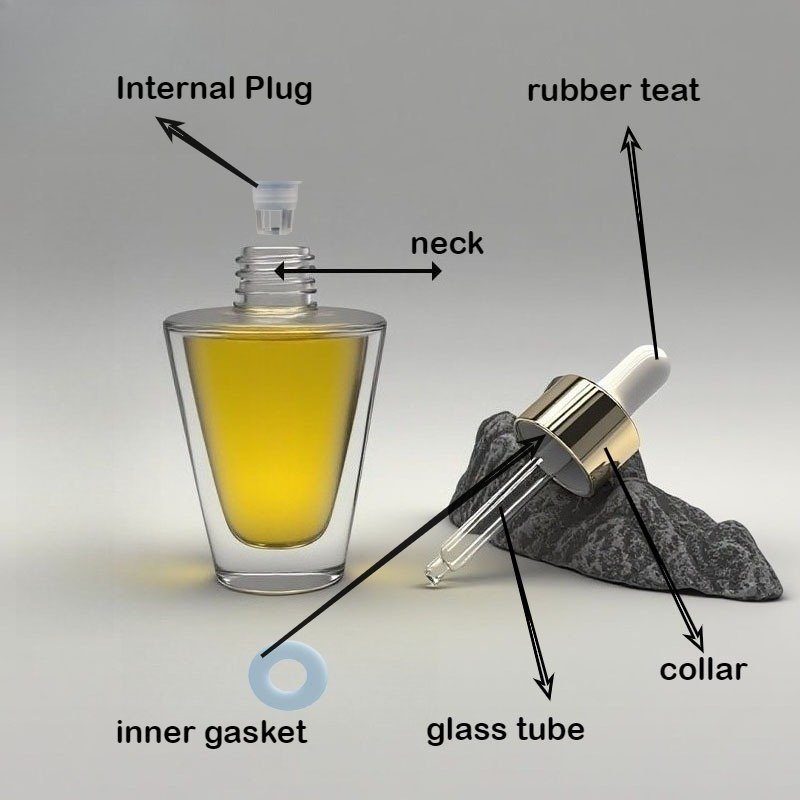
- Dropper Pipettes: These are typically made from either polyethylene (PE) or polypropylene (PP), both of which are petroleum-based plastics. Thus, their prices are directly tied to the cost of crude oil. Political instability in oil-producing regions or changes in OPEC policies can quickly affect plastic resin prices.
- Dropper Bulbs: The squeezable bulb is usually made from natural or synthetic rubber. The rubber market can be volatile, influenced by factors ranging from agricultural yields for natural rubber to the petrochemical industry for synthetic variants.
- Caps and Collars: These can be made from plastic, metal (like aluminum), or a combination. Aluminum prices fluctuate on the London Metal Exchange. Plastic caps, again, are subject to resin costs. Even the price of zinc, often used in the plating of metal caps, can be a factor.
- Colorants and Finishes: Special finishes like frosted (acid-etching), custom colors, or UV-protective amber glass require additional materials and processing steps, adding cost and complexity.
- Executive Summary for Busy Buyers: – Glass prices fluctuate due to energy costs & raw materials – Plastic components tied to crude oil prices – Shipping costs can vary up to 300% year-over-year – Customization increases price volatility by 15-40% – 5 actionable strategies to mitigate risk (see page 3)
Table: Key Components and Their Price Drivers
| Component | Primary Material(s) | Main Price Driver(s) |
|---|---|---|
| Glass Bottle | Soda-lime glass | Silica sand, soda ash, limestone costs; Energy prices for melting |
| Dropper Pipette | Polyethylene (PE) / Polypropylene (PP) | Crude oil prices, plastic resin demand |
| Dropper Bulb | Natural/Synthetic Rubber | Rubber commodity prices, agricultural & petrochemical factors |
| Cap/Collar | Plastic, Aluminum, Zinc | Crude oil prices, metal exchange rates, plating costs |
3. The Domino Effect: Supply Chain and Logistics
The COVID-19 pandemic was a stark lesson in global supply chain fragility, but the issues persist. The journey of a dropper bottle from raw material to your warehouse is long and complex.
Shipping and Freight Costs:
Most cosmetic glass is manufactured in Asia. Getting it to North America or Europe involves container shipping. The cost of shipping a 40-foot container can vary dramatically. Port congestions, a shortage of shipping containers, or geopolitical tensions affecting major shipping routes (like the Suez or Panama Canals) can cause freight costs to skyrocket overnight. These costs are typically borne by the buyer, either as a separate line item or built into a higher product cost.
Labor Costs and Availability:
Manufacturing glass bottles and assembling droppers is not fully automated. It requires skilled labor. As economies develop, wages naturally rise. Furthermore, events like the Chinese New Year can shutter factories for weeks, creating bottlenecks that tighten supply and can lead to short-term price increases.
4. The Power of Customization vs. Standardization
This is a crucial point where you, as the buyer, have direct influence. The more customized your order, the less stable the price will be.
- Standard Stock Items: A standard 10ml amber glass dropper bottle with a black plastic cap is produced in massive quantities. Manufacturers can plan long production runs, purchasing raw materials in bulk at better prices. This economies of scale leads to relatively stable and competitive pricing.
- Custom Items: The moment you request a specific color (like a custom pantone), an unusual size (e.g., 17ml), a unique glass finish (e.g., heavy frosted), or a custom-shaped bottle, you are moving away from standard production. This requires:
- Tooling and Setup Costs: Creating new molds for glass or plastic parts has a high upfront cost that is amortized over your order quantity. A smaller order will have a much higher per-unit cost.
- Minimum Order Quantities (MOQs): Custom items have high MOQs. Ordering below the MOQ will result in a significantly higher price per unit.
- Production Efficiency: Custom runs are less efficient than standard runs, adding to the cost.
Essentially, customization sacrifices price stability for brand uniqueness. It’s a trade-off.
5. Market Demand and Competition
The basic principle of supply and demand applies directly to the dropper bottle market.
- High Demand: When the essential oil, CBD, and natural skincare markets experience a boom, the demand for dropper bottles increases. If manufacturing capacity doesn’t keep up, prices will rise due to simple competition for available supply.
- Low Demand: During an economic downturn, demand may soften, potentially leading to price drops or special offers from suppliers looking to move inventory.
Furthermore, the number of suppliers you have access to affects price stability. Relying on a single supplier makes you vulnerable to their specific cost pressures. Working with multiple suppliers, perhaps in different regions, can provide a buffer and more negotiating power.
6. The Impact of Quality and Regulations
Not all dropper bottles are created equal. A lower price might reflect lower quality, which can be a false economy.
- Quality Control: Higher-quality bottles involve stricter quality control (QC) measures to ensure consistency in glass thickness, dropper seal integrity, and finish. This QC costs money. A supplier cutting corners on QC might offer a lower price but also a higher risk of defective products arriving at your facility.
- Regulatory Compliance: Depending on your market (e.g., FDA in the USA, CE marking in Europe), packaging may need to meet specific standards. Using compliant materials, such as FDA-approved food-grade glass and dropper assemblies, often comes at a premium compared to non-compliant alternatives. As regulations change, the cost of compliance can also change, affecting prices.
Strategies for B2B Buyers to Mitigate Price Instability
While you can’t control the global price of soda ash, you can adopt strategies to manage its impact on your business.
- Build Strong Supplier Relationships: This is number one for a reason. A trusted supplier is more likely to give you advance notice of price changes, work with you on payment terms, and prioritize your orders during shortages. View them as a strategic partner, not just a vendor.
- Plan and Forecast Accurately: The more accurately you can forecast your needs for the next 6-12 months, the better. This allows you to place larger orders during periods of favorable pricing, potentially locking in rates. Consider a hybrid model of stocking standard bottles in bulk while making smaller, custom runs more frequently.
- Consider Standardization: If brand identity allows, try to use standard sizes, colors, and finishes. The cost savings and price stability can be significant. Sometimes, a simple custom label on a standard bottle can achieve a similar effect to a fully custom bottle at a fraction of the cost and risk.
- Diversify Your Supplier Base: Don’t put all your eggs in one basket. Having relationships with two or three reputable suppliers, potentially in different geographic locations, gives you options and leverage. If one supplier has a price spike due to local energy costs, you may be able to source from another.
- Understand Total Cost, Not Just Unit Price: The cheapest bottle per unit isn’t always the cheapest overall. Factor in shipping costs, reliability, quality (and the cost of dealing with defects), and payment terms. A slightly higher unit price from a reliable supplier who delivers on time every time is often a better business decision.
Conclusion: Embracing Informed Purchasing
The price instability of essential oil dropper bottles is a complex issue rooted in global economics, supply chain dynamics, and the specific choices you make for your brand. It is not a sign of a dysfunctional market but rather a reflection of a deeply interconnected global manufacturing landscape.
By understanding the “why” behind the price changes—from energy costs to custom tooling—you transition from a passive buyer to an informed strategic partner. This knowledge allows you to ask the right questions, negotiate more effectively, and develop a sourcing strategy that protects your business from the worst of the volatility. The goal is not to find a magic source with perfectly stable prices, but to build a resilient supply chain that can adapt to an inherently unstable environment.
## Frequently Asked Questions (FAQ)

Q: How often do dropper bottle prices typically change?
A: Most suppliers review pricing quarterly, but sudden changes can occur with energy price spikes.

Q: What's the price difference between standard vs. custom bottles?
A: Custom bottles typically cost 20-50% more due to tooling and lower production efficiency.

Q: Can I lock in prices for a season?
A: Yes, many suppliers offer price protection on bulk orders (e.g., 50,000+ units) for 2-3 months.